Showing posts with label 2006 Summit. Show all posts

Sunday, August 13, 2006

Building knowledge through narrative

Susan Sechrist is a communications consultant who specializes in improving scientific and technological literacy through the use of figurative language and narrative voice. She views the technical communicator’s responsibility as promoting understanding, as well as inspiring inquiry and participation. To learn more about Susan’s work, see The Writer’s Role: A Narrative Voice or visit her Web site.

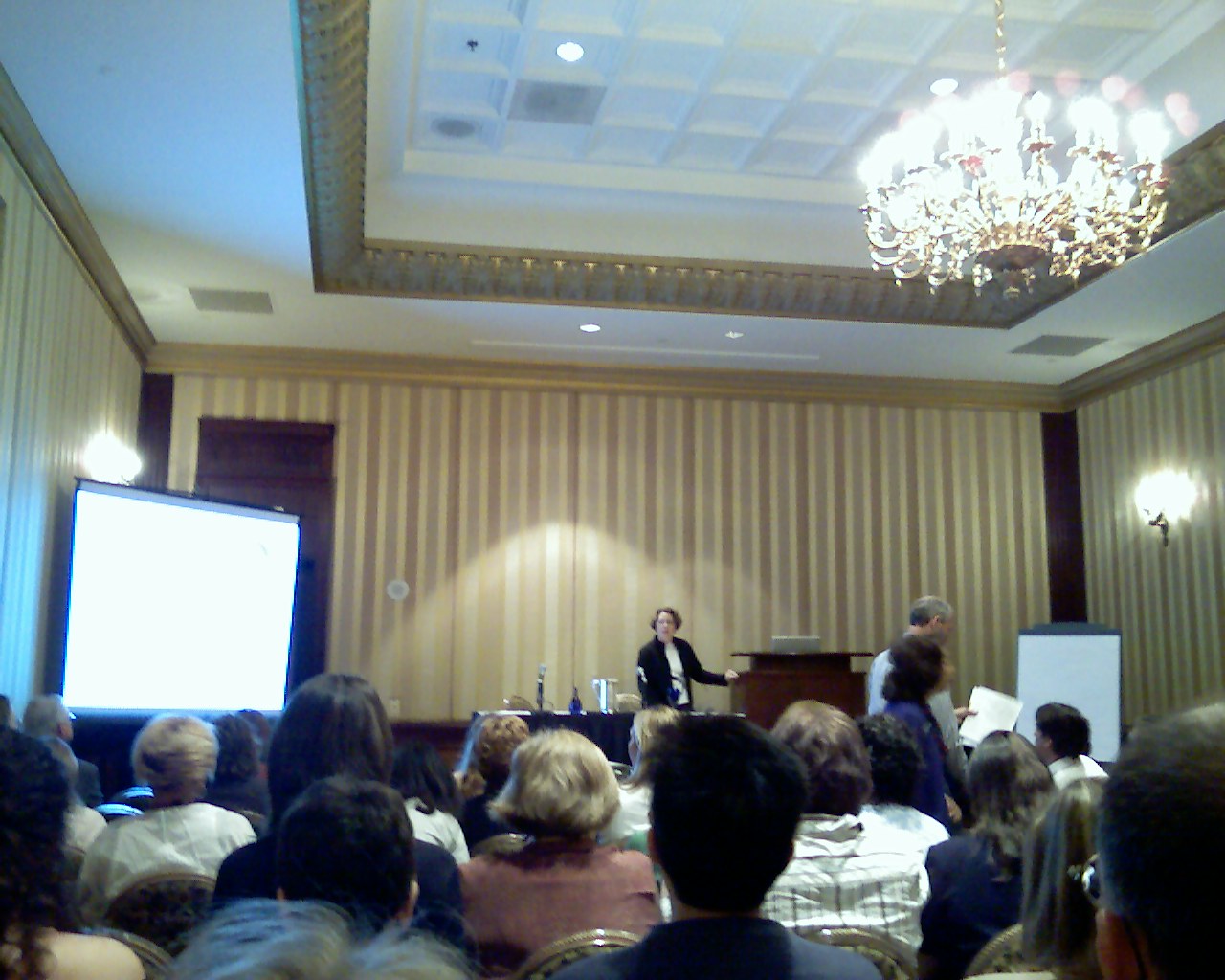
Attendees arrive at Susan Sechrist's presentation in Las Vegas this year.Thank you, Susan, for sharing your views with readers of the Blog at STC Chicago.

Q: Why is narrative voice important to science and technology writers?

A: I think the challenge in making scientific and technological ideas accessible is to find common ground between scientists and the general public. Often, scientific ideas are only discussed in highly technical, specialized journals or magazines, where there is a shared language, or at least an expectation on the part of the audience to learn the jargon. While this is useful on some level, it leaves out a whole population of people that are affected by the science or the technology, people who can not only benefit by understanding the science better, but can also offer the scientists insights. I think narrative is better equipped to provide this two-way street, this dialogue.

Throughout history, cultures have used narrative and storytelling to pass on important information. Myths are often encoded with detailed information about geological or meteorological events, information that may be critical to the survival or success of a tribe or culture. It is also a way to store historical information and decisions. Narrative is natural to the human cognitive processes; we remember stories better than we remember lessons. Think back to a day in elementary school when your teacher told you a personal story about his or her experience--that story is probably more vivid in your memory than the day you learned the textbook lesson about George Washington crossing the Delaware.

I always thought science was particularly suited to explanation by metaphor--it was the way I understood many complex ideas. For example, there is a beautiful process in cellular metabolism called phospholipid fluid mosaic transport. The cell membrane is a mosaic of proteins, each specialized to pass (or block) a particular substance from the interior of the cell. I thought of each of these proteins as a messenger, bringing information back and forth. The metaphor of the messenger intrigued me enough to learn more about the process. Narrative allows us to visualize more readily, metaphor helps us build connections that we might not otherwise seek out. I think narrative makes us more curious, more questioning. It also allows us as individuals to contribute to the story--this is why I think a narrative or storytelling approach is vital in presenting scientific and technological ideas. Everyone has a right and a responsibility to participate in scientific inquiry. We must find ways to invite people, all people, into the dialogue. I don't think this means dumbing down the complexity of the scientific approach. I think it means coming at it from many different angles.

Come back soon to read Parts II and III of our interview with Susan.

Friday, July 14, 2006

Dan Voss on integrated strategic communication

Dan Voss presents at the 53rd STC Annual ConferenceDan Voss is a technical communicator with 28 years of experience in the aerospace industry. An STC Fellow and active member of the AccessAbility SIG and STC Orlando, Dan understands the challenges and opportunities facing today’s technical communication professionals. In his presentation at this year’s conference, he argued that technical communicators are uniquely positioned to interact with and moderate among teams in marketing, advertising and PR.

Welcome to the Blog at STC Chicago, Dan! Thank you for sharing your views about integrated strategic communication with us.

Q: Why should technical communicators care about the synergy between technical communication and marketing?

A: For several reasons. First, the synergy between technical communication and marketing communication can add substantial business value to information products—helping your company or clients win new business and defend the business they have. Second, technical marketing communication offers excellent career opportunities for technical communicators because it requires a unique combination of technical understanding and core communication skills that we possess. Third, if you are in “corporate America,” internal business alliances are an important part of both organizational and individual success. In the aerospace industry, for example, technical marketing communication requires a close alliance among technical communicators, business development, engineering, and program management—pairing us with three of the most powerful disciplines. That, in turn, increases our influence and our respect within the company—both as an organization and as individual professionals. Fourth, technical marketing communication is exciting. It’s varied, it’s high-energy, and it’s fun.

Q: You’ve worked extensively with remote teams to incorporate video and other multimedia into your proposals. Are you convinced that new media tools enhance the technical communicator’s ability to engage and persuade an audience?

A: Absolutely, especially when that audience consists of high-level decision-makers who are less technical (e.g., Congressional staffers, top military officers, corporate executives). Video and multimedia are somewhat less important when you’re dealing with a detail-oriented highly technical audience, but they can have a role in informing and clarifying as well as in persuading, so I believe they are also effective across a heterogeneous audience. As an example, in the technical volume of the proposal I described in the conference session, we included more than 40 imbedded video clips showing tests of missile subsystems. The primary readership of that volume was a highly technical audience, yet the video was still able to accentuate our theme of high product maturity and low development risk. For top-level audiences, we also provided an executive summary video, in addition to the hard-copy exec sum that was called for in the RFP. And multimedia was a critical element in the marketing/media campaign that followed submission of the proposal, because here again, the target audience was non-technical.

Q: Do you find today’s technical communication professionals ready and willing to integrate video and other multimedia into complex documentation projects?

A: It’s hard for me to comment meaningfully on that, because I have been with one company for the past 28 years, and it happens to be a company (and a communications department) where the value of integrated communication across a full suite of media has been demonstrated and the process is integral to our new business pursuits. I can only offer a speculative answer to this question based on my observations when I have made presentations on integrated communication for STC, both at the chapter level and the international level, as well as an analysis of the feedback that comes with the conference evaluation forms. To generalize, I think audience members who are documentation specialists are definitely interested in—in some cases, even intrigued with—the possibility of integrating video and multimedia into their projects, but some audience members found the “full-court press” we put on in the media/marcom campaign, while interesting, to be far afield from their day-to-day job responsibilities in documentation.

Q: Is it fair to say that, in order to create successful technical proposals, technical communication professionals need to be well-versed in new media strategies?

A: Not so much on the proposals themselves, but definitely the media/marketing campaigns that often accompany and/or follow proposal submission, in an effort to influence the source selection process. Note that my experience is entirely within aerospace, so I cannot speak knowledgeably concerning the degree to which the integrated communication concept (proposal plus media/marcom activity) applies there, but I would imagine that a broader skill set would make enable technical communication professionals to provide increased business value in that environment as well.

Thanks again, Dan, for taking time to talk with us about integrated communication and the technical communication profession.

Tuesday, July 11, 2006

Session materials updated

New materials have been added to the conference site. According to the official count, there are now 205 presentations available for review.

Monday, June 26, 2006

Who blogs about the STC conference?

To find others who've blogged about the conference, check out the following search results. You'll find posts from STC Chicago and others. The lists aren't comprehensive, but they'll give you a quick look at conversations taking place online. See:

Technorati and BlogPulse

Want to find blogs that feature posts about the Society for Technical Communication? See:

BlogPulse and Technorati

Wednesday, June 14, 2006

STC podcasts available

Two podcasts from this year's conference are available at the STC Web site. Topics include "Best Practices for Chapter Public Relations" and "Organizing Profitable Chapter Events."

Wouldn't it be great to have access to all of the sessions via podcast?

Others have been working on this. The Conversations Network is a non-profit organization whose mission is to record and preserve events, meetings and other happenings:

Every day scores of educational, inspirational and entertaining conference sessions, lectures and other spoken-word presentations are lost. They simply evaporate because no one records them. Some of these presentations are by the greatest and most inspiring minds of our time, and many would be important to people in the far reaches of the planet, if only they could hear them.

The Conversations Network (a California non-profit corporation) captures presentations, processes the recordings, and publishes them online for free under Creative Commons licenses. >>Continue Reading
For news and resources about podcasting and other emerging technologies, see IT Conversations.

Also of interest: In April, Boston University hosted the Podcast Academy. You can read more about it here. The next Podcast Academy event will take place this September in conjunction with the Podcast and Portable Media Expo.

Friday, June 09, 2006

Casting a really wide (broadband) net

This year in Las Vegas, Beth Agnew, technical communication instructor at Seneca College of Applied Arts and Technology in Toronto, Canada, made the case for including podcasts and vidcasts in technical documentation. I asked her to share her views on multimedia content and the technical communication profession.

Thanks, Beth, for taking time to share your views.

Q: You're interested in producing and editing videos and podcasts, software demonstrations and other online instructional materials. Just how popular is multimedia documentation?

A: We’re not seeing widespread use just yet. I think that is the legacy of the inability of the web to deliver good quality multimedia prior to recent years. But now that most people have fast broadband connections and plenty of disk space for storage, there will be more multimedia generated. New tools such as RSS feeds, aggregators, .mp3 players and ipod video give users more options for viewing multimedia. Once you have the distribution method (the web) and the installed based (a multimedia player-equipped audience) the content producers can start to churn out material. People like multimedia. We’re visual beings accustomed to receiving information through multiple channels. It only makes sense that we want to have material delivered via multimedia.

Q: But what about professional production techniques? Rhetorical principles? Are tech comm professionals currently up to the challenge?

A: We missed the boat when the web was in its infancy--instead of embracing this new technology and taking a pre-eminent position in creating content for the web, the web developers and graphic designers rushed to the forefront to create beautiful, functional web sites that users found frustrating. Even now, hiring a technical communicator to manage your website project is not the first thing most companies think of--but it should be. The same thing could happen with multimedia. The techies are getting out there because they are developing the technology; the musicians and videographers are out there because they’re familiar with the tools of the trade. But delivering information and instruction via multimedia takes more than cool sounds and pretty video. It takes carefully crafted content. The rhetorical principles we use for written documentation still hold true for podcasts and online video. There has to be some organizational strategy applied, the information has to be chunked and managed, and the user’s needs have to be considered. These principles are not top of mind for the audio and video producers who are moving their work to the web. Tech comm professionals need to grab hold of this technology, learn it, adjust it to meet our needs as communicators and trainers, and drive the industry toward usable multimedia.

Q: Are technical communication departments at universities and colleges hiring multimedia specialists to address this growing demand?

A: Not yet. Our universities and colleges are still not entirely up to speed with the latest technology. While there are pockets of technology-enhanced learning, most institutions are lagging behind the student population as far as technical knowledge. They’ve got a preponderance of baby-boomers as instructors, teaching students who grew up with the web. That creates a huge generation gap. To their credit, however, learning organizations recognize the importance of technology and are moving forward to try to catch up. The creation of campus e-learning centers and hiring experienced multimedia specialists will help address the needs of students who want course materials delivered in audio and video channels.

Q: You discuss the influence of “reality TV” on instructional video. What do you think about the trend toward “informal” instruction and the use of humor to teach online? For example, I’m thinking of sites like Photoshop TV. Is this the future of technical communication?

A: There will always be a place for “formal” technical communication, just as there is still a place for books. As technical communicators, we are always acutely aware of our audience and the needs of our users to acquire the information we have to give them. Those needs now include informal, in the street, quick uptake, short burst information delivery. Who has time to deal with a 300-page manual any more? The future of technical communication is delivery of information to our audience in the most effective way. That has always been what we’re about. That principle won’t change. We are successful when we make a connection with our audience. One or two experts, showing hands-on instruction, and speaking to the audience in a casual way creates rapport, and a very solid connection with the user. You like these people. They are credible, they are sincere, you believe them, and you become a loyal user. They entertain you, you learn something, and you feel better for having spent your precious time in that way. That is definitely the future of technical communication.

Q: Any favorite sites you’d like to share?

A: I’m a fan of Kitchen Arts, a great way to show how to use kitchen gadgets you might want to buy. This is a super example of merging marketing with information. Another good site is of course TechSmith as I mentioned in my presentation. They use their own technology to show you how to do a good multimedia presentation. Finally, another website that is fun is Makezine.com - audio and video podcasts by hardcore DIY-ers who have taken how-to information out of the cubicle and the studio and into the backyard and living room. The more accessible we make technical communication, the more it will help our users.

Thanks for taking time to talk with us, Beth. Be sure to check back for comments on this topic.

Wednesday, May 31, 2006

The way we work today

At this year’s conference, Hillary Hart and Jamie Conklin shared insights from their research on "New Models and Images for Technical Communication."

LJ: Thank you for taking time to talk with us about the “Models and Images” project!

The ability to articulate the value of technical communication is important in today’s competitive marketplace. Your research suggests that technical communicators are describing the work they do in new, and sometimes surprising, ways.

HH & JC: We found that as soon as we asked focus-group participants to think about metaphors, models, and images that would accurately describe what they do in the workplace, folks came up with an amazing array of active, performance-based, empowering and empowered descriptors. Words like “director” and “orchestra leader” and “juggler,” all of which came up in every group, speak to a sense of authority and performance that we found surprising. Also, in the dominant category we call Emerging Forms, descriptors such as “evangelist,” “architect,” and “coach” invoke positions of power and huge impact on others.

What happened to all those shy, introverted technical communicators of yore? The groups we spoke with certainly talked about the struggle to be “heard” in their companies and organizations, but they had no doubt about the necessity and importance of being heard - -importance to the core missions of their companies. These technical communicators were focusing their energies on engaging all sorts of people, internal and external to their organizations, in enhancing the flow and quality of information. Developing both the information itself and the uses of it were seen as work that cannot be offshored.

We also found that though technical communicators continue to talk about demonstrating their value, they are now also keen to become more influential within their organizations and on their project teams. Perhaps we are seeing practitioners shift their emphasis from “proving it” to “doing it”—maybe we are no longer so interested in developing a generalized business case for technical communication that we can base on an STC-sponsored study, and are more interested in rolling up our sleeves and taking leadership in our own workplaces?

Of course, communicators are also producing a dizzying array of products, that was clear.

LJ: You find that, increasingly, technical communicators are adopting a process-oriented approach for their work. What can you tell us about the impact of this approach on creativity and innovation?

HH & JC: Our research, which was based on focus groups and a conversational method, did not touch specifically on creativity and innovation. Certainly the technical communicators we met with seemed to be creative and innovative people, but we were not exploring the relationship between work situations and innovation.

However, it certainly was evident that the technical communicators we met with see their value and purpose more in relation to the processes they contribute to than to the deliverables they produce. We wonder if this is evidence that technical communication practice is becoming increasingly social and interactive, and that practitioners are contributing largely through the ways they participate on teams.

LJ: Your research describes “self-actualization” and “transformation of the profession” as important professional objectives for those in technical communication.

HH & JC: It is not so much that we see these as important objectives, as it is that the people we met with tended to talk about these things. When we asked people to tell us about their personal objectives, they most often mentioned significant and potentially transformative goals. For example, more than once people talked about their desire to build community. One academic talked about wanting to develop a more complete or profound understanding of the needs of users. A consultant told us that she had moved her practice from user advocacy to user empowerment. Other people talked about wanting to write plays or novels, and still others spelled out their vision for leadership of the profession.

We wonder if these far-reaching personal objectives, which usually went far beyond the recent concrete achievements that people described, imply that many technical communicators are feeling increasingly confident and ambitious. Imagine a cohort of resilient, determined technical communicators who are intent on bringing the value of their discipline to their organization, come hell or high water. This may be wishful thinking on our part, but we wonder if the profession has matured to the point where we are shifting from the “business case phase,” where we try to describe our value to others, to the “evidence in action” phase, where we individually take concrete steps to bring our value to our teams and organizations.

LJ: Thank you for talking with us about this important topic. We’ll look for a complete report on your research to be published in Technical Communication later this year.

Wednesday, May 24, 2006

Conference calendars of interest

The STC Management SIG list is really active today discussing how to make next year’s conference even better than it was this year. Why not start planning for next year’s conference today? We know where future STC conferences will be held:

Minneapolis, MN 2007
Philadelphia, PA 2008
Atlanta, GA 2009

Source: Intercom

Other conferences of interest before then? Two good lists have appeared. Check Current Events at InfoDesign and the post on Web 2.0-related conferences at Brand Dialogue.

Thursday, May 18, 2006

Holly Harkness on change management

Holly Harkness, Manager of IT Documentation at Mirant Corporation and incoming president of STC Atlanta, presented her views on change management at the conference this year. We're following-up with Holly to discuss this important topic.

Hello, Holly. Welcome to the conference blog at STC Chicago! Your presentation on change management really struck a chord with those who attended.

Thanks! I was pleasantly surprised at the number of people who showed up.

Q: If you had your way, would all technical communicators add the change management skill set to their portfolios?

A: Yes! Good technical communicators are probably already instinctively implementing change management strategies in their work, but I’d recommend that everyone in our profession take the time to become familiar with this growing field so that they can articulate it to their management or prospective employers. We should be selling this as an added service we can provide.

Q: You’ve written about two fairly recent opportunities where technical communication professionals needed to adjust to rapidly changing environments: Y2K and Sarbanes-Oxley. Do similar opportunities exist out there today?

A: Good question! I’ve just agreed to deliver an STC Webinar in the fall on “Ten Ways to Increase Your Value as a Technical Communicator” where I’ll take up this subject in more detail.

One potential opportunity for technical communicators is disaster recovery or business continuity. After 9/11 many organizations began to take this more seriously. After Katrina, executive managers were even more convinced to fund these kinds of programs (even as they are cutting other types of projects).

Where do we come in? In a disaster, communications and clear procedures are key. Employees need to know what to do and where to go to keep operations going. Technical communicators are well positioned to take on this documentation effort. In addition, there’s a huge IT component to business continuity that requires detailed documentation that can be understood by the personnel who are tapped to start up the networks.

Q: Will you be offering workshops in change management through your chapter? Is this type of workshop STC chapters and SIGs should pursue? And, do you think change management will become an important career path for tech comm professionals?

A: I spoke at our chapter meeting on this topic last year, but workshops are a good suggestion –- for both chapters and SIGs.

This career path will probably appeal more to technical communicators who enjoy project management, training, and other people-oriented activities. But some aspects of this profession are less appealing, such as becoming a spin doctor for bankruptcies, layoffs, plant closings.

I think the biggest immediate opportunity for tech comm professionals to participate in change management is on the project level rather than the corporate level.

Q: In your opinion, what was one of the highlights of the STC Conference in Las Vegas? And what would you like to see next time that you didn’t see this year? I guess I’m asking, “What would you like to change” about the conference?

A: The highlight for me was the Leadership Day presentation of the plans for the upcoming year. (This is what I would change about the conference as well. All the conference attendees should hear about these developments, not just the small group that shows up for Leadership Day.)

I’m excited about the commitment to promote our profession and to adopt an international perspective. The global character of STC was really apparent this year! I loved hearing Tang Graat’s description of the Trans-Alpine chapter’s activities in Europe, including their Chocolate Raffle fundraisers. In two separate discussions, STC members who live and work in the US told me they’d joined the India chapter to strengthen ties with their coworkers and colleagues in that country. This kind of collaboration is fantastic.

Great talking with you, Holly! Thank you for sharing your views with us.

Thanks for inviting me!

For more from Holly, visit the new blog she's started as incoming president of STC Atlanta.

Tuesday, May 16, 2006

Session materials available for review

Don’t forget to check out the STC Session Materials page for presentation notes and slides.

If you liked my post on the “Future of Technical Communication,” you’ll find the following presentations interesting: Check back again for more. We’ll have contributions from some of the presenters listed above.

Friday, May 12, 2006

Back to Chicago and the future of technical communication

STC-Chicago members may be headed home from the conference today, but they aren’t done blogging about their experiences in Las Vegas. Me? I’ll be talking about emerging roles and new opportunities in the field of technical communication.

Interested in the future of technical communication as I am, I sought out conference sessions with the phrases “new roles,” “future of,” “new media,” “consumer-generated content,” “technical marketing,” “integrated communications,” “strategic,” and “business analysis” in their titles.

Luckily, plenty of tech comm people in Las Vegas were interested in new directions for the field. My professional experience tells me, and recurring themes I’ve heard at the conference lead me to believe, that technical writing and editing will continue to be key to the work we do. Increasingly, however, those in tech comm will become known for their expertise as business strategists.

Learning how the work we do fits into the larger, strategic goals of our organizations will help us to articulate thoughtful, integrated communications strategies and to work across teams and geographies, spurring innovation and creating productive partnerships as we go.

More on this in future posts, as well as input from attendees who presented on these topics at the conference. Stay tuned.

Wednesday, May 10, 2006

Taking the scenic route between sessions


The view from the top of the Eiffel Tower at the Paris Hotel.

What happens in Vegas . . .

...need not stay in Vegas. At least not while STC-Chicago members are reporting from the street.

As promised, this blog brings news, stories and photos from the conference. We've already provided post-transformation updates, including news about the selection of Susan Allen Burton as STC Executive Director. Susan begins her new role in August 2006. More information will be available soon at www.stc.org.

We'll continue reporting even after the conference is officially over, so keep checking back for updates. Better still, make use of the RSS feed provided on the right-hand side of this page.

Key notes


It’s true. Great technical sessions here. Networking, too.

Keynote speakers Cerf and Kahn offered an interactive Q&A session Monday morning after the address. They talked about new challenges and opportunities for technical communicators. Key issues faced by those in information architecture? Tracking project documentation and archiving data in new ways to increase availability and security over time and technologies.

Check here for a recent NPR interview with the speakers.

Tuesday, May 09, 2006

Quick hi from a conference attendee/new blogger

Almost two-thirds of the way through the conference...it's been interesting, and I've probably done more walking between the two hotel conference centers and other tourism sites than I normally do in a week.

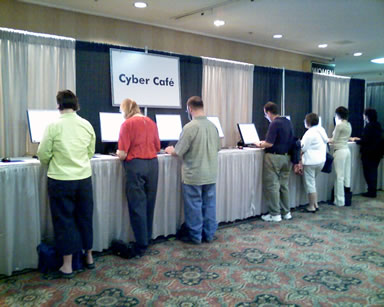
I'm Paul Lockwood, by the way, a TransUnion associate and Chicago STC member attending the conference who's never blogged before. And I'm trying to think quickly as I use a "Cyber Cafe" computer here to enter my thoughts, hopefully not delaying too many other people who might be waiting to use a PC.

This is--best as I can recall--my fifth STC conference in the 15 years that I've been in the technical communication field. It's always interesting to reacquaint myself with friends from the Orlando (where I used to live) and Chicago chapters...and to meet new people from all over the world (a Belgium representative was at a workshop table this morning).

The exciting thing about STC conferences is the wide variety of sessions offered during each time slot--you're sure to find something that you or your company might want to know more about. The problem is that you often have multiple sessions in the same time slot that sound interesting. Until they figure out a way to clone humans that's affordable, I guess I'll be attending one session per period...unless I duck out early on if the presentation doesn't sound exactly like what I thought it would be. DITA, translation, editing--all sessions I'm trying to get to...and get something out of. Very intelligent people presenting these sessions, as usual; now if I can just grasp all of the acronyms and subject matter, I'll be doing well...!

The entertainment possibilities in Vegas are endless, of course. Saw the hilarious Rita Rudner Monday night; going to see the Tony Award-winning comedic musical, "Avenue Q," this evening; checking out Don Rickles Thursday night.

Better get off the computer; hope this post wasn't too boring!
Paul

Monday, May 01, 2006

Live from Las Vegas . . .

That's right! We're getting ready to report from the STC Annual Conference.

Welcome to our new blog, where conference attendees will have the opportunity to share their stories, insights and photos with the Chicago chapter and beyond. This blog will be the "go-to" spot for updates about the people, places and technologies featured in Las Vegas this year.

As you can see, Betsy Maaks has posted some pre-conference musings. Thanks, Betsy, for kicking off this effort. Attendees should feel free to start posting. It's easy!

If you are an STC-Chicago member and are attending the conference this year, please let us know. We'll help you to get started with the blog.

Contact us today to begin blogging.

Saturday, April 08, 2006

STC Annual Conference


STC Annual Conference

May 7-10, 2006
Las Vegas, Nevada

For more, click here.

STC Chicago Announcements

STC Chicago

STC Blog

Society for Technical Communication